Cryptogram: Logic Puzzle Game
- 4.8
- Rating
- 500.00K
- Installs
- Free
- Price
 Analysis by App-foxy
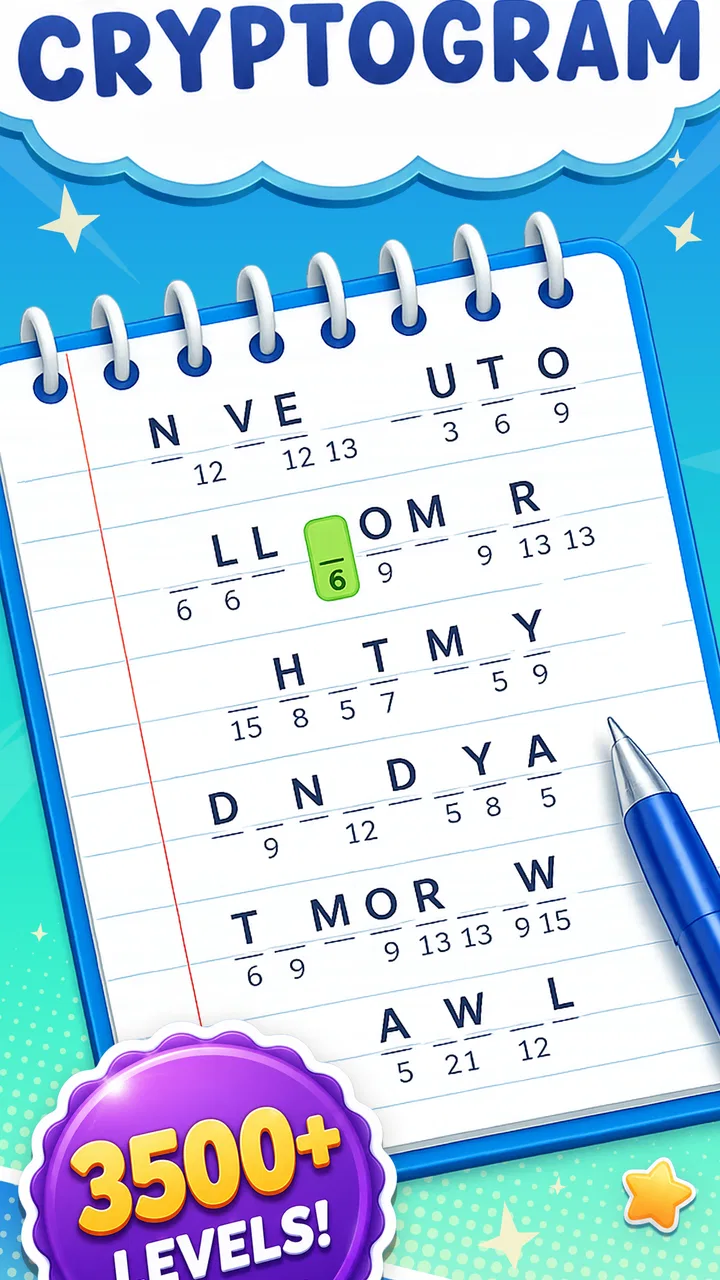
I spent time with Cryptogram: Logic Puzzle Game as a quiet word-game option rather than a fast, competitive distraction. Its basic idea is easy to understand: decode a puzzle and uncover a hidden message by using logical relationships between letters. That makes it approachable from the first session, but the real appeal is in the small decisions that follow. Each solved character gives me another clue, and a promising guess can either open the whole puzzle or expose a mistake several steps later.
This is a free word game from Tripledot Studios Limited, aimed at Everyone and available for devices running Android 7.1 or later. The current version is 1.09.00, and it has passed the early stage of its release with over fifty thousand installs. Its average rating is 4.6 from roughly one thousand ratings, with around forty reviews. Those figures suggest a positive initial reception, although I would still treat the game as a focused puzzle experience rather than a large, established word-game platform.
What I liked most is that the game does not require a long explanation before I can begin thinking. What deserves closer attention is how comfortable that thinking process feels for different readers, different hands, and different situations. A puzzle can be logically fair and still become tiring if the text is difficult to read, the controls demand too much precision, or the surrounding environment makes concentration hard. That is where this game is easier to recommend to some people than to others.
You May Also Like

 Blood Strike: 2.5 Anniversary
Blood Strike’s Loadouts Turn Every Drop Into a Tactical Gamble
A close look at Blood Strike’s custom loadouts: how fast access to signature weapons reshapes its battle royale rhythm, rewards preparation, and narrows the gap between fights.

 Pandora - Music & Podcasts
Pandora’s Music Is Easy to Start, but Harder to Recover
Pandora’s strength is its low-effort path from a seed to a station. Its weak spot is how much confidence it asks you to place in connection, setup, and quiet recovery.

 8 Ball Pool
 Is Built on Rivalries, Rematches, and Routine
A close look at the rivalries, rematches, shared routines, and unanswered safety questions that turn a quick pool match into a persistent mobile community.

 Samsung Music
’s Quiet Strength Is Playing What You Already Own
Its reach comes less from spectacle than from dependable access to a personal library. That simplicity is both the app’s strongest retention engine and its ceiling.

 AccuWeather: Weather Radar
AccuWeather Review: A Quick, Clear Forecast for Everyday Decisions
For everyday plans, the best forecast is the one you can understand quickly. AccuWeather makes rain timing, radar, and local conditions easy to act on, with a few trade-offs.

 Hill Climb Racing
Why Hill Climb Racing Still Turns Crashes Into One More Run
A tiny car, a bumpy hill and one more upgrade: Hill Climb Racing keeps resurfacing because its simple chaos makes every near-miss feel personal.
More From Our News Desk



How the puzzle experience works in everyday use
I find the best way to judge this kind of cryptogram is to notice how each small deduction changes the whole message, rather than treating every blank as a separate guess. That connected logic is what makes a brief session feel satisfying, but it also means interruptions can break my train of thought. Next, I’d look at how to keep the solving process manageable when I’m playing in ordinary, stop-and-start moments.
Readable enough for short sessions, with a simple mental layout
The central task is familiar to anyone who has tried a cryptogram: letters stand in for other letters, and I use repeated patterns, word shapes, and likely language to reconstruct the hidden sentence. I do not need specialist knowledge to start. Instead, I look for a repeated symbol, test a common short word, and then see whether the same substitution makes sense elsewhere. That gradual chain of deductions is more satisfying than simply guessing a phrase from a list.
The game’s strongest readability quality is conceptual rather than decorative. The puzzle presents one problem at a time, so my attention stays on the encoded message instead of being split between a large collection of modes. This helps when I am playing for a few minutes during a break. I can return to the same kind of reasoning without first remembering a complicated control scheme or a long set of rules.
There is also a useful distinction between visual reading and mental reading here. Even when the letters are clear, cryptograms ask me to hold several substitutions in mind at once. A player who enjoys word patterns may find that process stimulating, while someone who finds dense letter sequences tiring may need shorter sessions. I recommend solving the first few clues slowly rather than trying to fill the entire message immediately. One reliable substitution is usually more useful than several rushed guesses.
My practical method was to scan for repeated patterns before entering anything. If a group of symbols appears more than once, I compare its position and length with familiar words. I then use the least risky deduction first and watch how it changes the rest of the sentence. This approach reduces the frustration of replacing a chain of guesses later. It is a small but important workflow improvement, because the game rewards careful elimination more than speed.
For readers who prefer large visual targets and highly adjustable presentation, the experience may feel less flexible than a dedicated accessibility-first puzzle tool. I would not choose it on the assumption that every visual preference can be customized. Instead, I would try a sample puzzle on the intended phone and check whether the encoded text, controls, and feedback remain comfortable at the device’s normal display settings.
Navigation is approachable, but the puzzle itself creates the workload
I found the basic navigation easier to understand than the underlying deduction. That is the right balance for this type of game: the interface should stay out of the way while the player works on the message. There is no benefit in making a cryptogram difficult to reach, and the game’s appeal depends on getting quickly from opening the app to examining the next clue.
The more demanding part is moving between visual inspection and input. I may notice a pattern in one part of the sentence, enter a possible letter, and then check its effect somewhere else. That back-and-forth is not a navigation problem in the usual sense, but it is a genuine cognitive load. Players with attention difficulties may find it helpful to pause after each deduction and mentally label it as certain, likely, or experimental.
That three-level habit is one of my favorite ways to make the game less overwhelming. Certain substitutions can guide the rest of the puzzle. Likely ones should remain provisional until another word supports them. Experimental guesses are best avoided unless the message has become nearly obvious. Treating every answer as equally reliable is the quickest route to confusion, especially in a sentence with repeated letters.
The game works well as a solo activity because the reasoning is self-contained. I do not need another player to explain a turn or judge whether an answer is acceptable. On the other hand, people who enjoy social word games, timed rounds, or a large variety of puzzle formats may find the experience narrow. Its focus is a strength for concentration, but it also means there is less to do when I am not in the mood for letter substitution.
Motor and sensory comfort depend heavily on the device
A cryptogram is naturally less demanding than a game built around rapid movement. I can think before acting, and the core interaction does not depend on reflexes. That makes it a better fit for players who prefer deliberate touch input or who avoid games that require repeated fast gestures. I could approach a puzzle at my own pace rather than feeling punished for taking a moment to inspect the sentence.
Still, relaxed pacing does not remove every motor concern. Entering letters repeatedly can become tedious for anyone who has difficulty with precise taps, hand fatigue, tremors, or one-handed phone use. The practical question is not whether the puzzle is fast, but whether the controls are comfortable over a complete solving session. I would test it with the phone held in the hand I normally use, especially if I expect to play while standing or commuting.
There is a useful trade-off here. A player can slow down the reasoning, but may not be able to reduce the physical effort of entering many characters. For that reason, I would recommend shorter rounds to someone with limited stamina rather than treating the game as an activity for extended continuous play. A puzzle that feels pleasant for ten minutes may become noticeably more tiring when repeated without a break.
Visual contrast and letter size matter just as much as touch accuracy. Cryptograms place many symbols close together, and a single misread character can lead to an apparently logical but incorrect theory. Players with low vision, light sensitivity, or difficulty distinguishing similar letter shapes should pay attention to whether the screen remains legible in their own lighting conditions. A bright outdoor setting, a dim room, and a moving vehicle can produce very different results.
For players who rely on spoken output, switch access, magnification, or other assistive methods, I would be cautious and test the complete interaction rather than assuming that a simple word game will automatically be easy to operate. The game’s underlying logic is accessible in the everyday sense that it does not demand quick reactions, but the practical experience still depends on how the device exposes text and touch controls. That distinction is important.
Situational access: where it fits and where it does not
This is a good companion for a quiet waiting room, a short break, or an evening when I want something more active than scrolling but less demanding than a full strategy game. Because the puzzles can be approached in small portions, I do not need to reserve a long uninterrupted block of time. I can inspect a phrase, make one or two deductions, and stop before the task becomes a commitment.
It is less suitable in noisy or visually unstable surroundings. Solving depends on noticing repeated structures, so conversation, glare, vibration, and frequent interruptions make the experience much harder than they would make a simple matching game. I would not use it while walking, cycling, or doing anything that requires environmental attention. The slow pace may feel safe compared with an action game, but the mental focus can still pull attention away from the real world.
A realistic everyday example is a train journey with a few stops remaining. I can begin by identifying repeated symbols, work through a likely short word, and leave the puzzle unfinished if my stop arrives. That flexibility is useful. However, if the carriage is crowded and I am holding a bag with one hand, the repeated input may be less comfortable than expected. In that situation, a paper word puzzle or an audio-friendly game could be a better choice.
The game also suits people who want low-pressure language practice without committing to a lesson format. It encourages attention to spelling, word frequency, and sentence structure, although I would not treat it as a complete language-learning course. Someone studying a language may enjoy the pattern recognition, but the game’s main goal is solving the encoded message, not teaching vocabulary, pronunciation, or grammar in a structured sequence.
For children, the Everyone age rating makes the game broadly approachable, but suitability still depends on reading ability and patience. A child who enjoys word riddles may find the substitution logic rewarding. A child who expects immediate visual rewards or highly animated action may lose interest. I would play alongside a younger reader at first, not to solve the puzzle for them, but to show how to test a clue without guessing every letter at once.
What can interrupt an otherwise clean solving flow
The biggest limitation is repetition. Once I understand the substitution method, the pleasure comes from the individual message and the quality of the deduction, not from learning a new game system each time. That is ideal for players who want a consistent mental exercise. It is less convincing for anyone who needs constant novelty, varied objectives, or a strong sense of progression beyond solving one cryptogram after another.
There is also a potential tension between free access and optional spending. The game is free to download, while its in-app purchases range from $0.99 to $99.99 per item. That wide range means I would approach purchasing carefully and check each prompt before confirming anything. A player who wants a completely purchase-free routine should decide in advance not to spend and should make sure the device’s purchase controls match the household’s needs.
I also would not confuse a high average rating with a guarantee that the game will suit every reading style or phone. Ratings can tell me that many users enjoyed the core idea, but they do not replace a personal check of text comfort, touch accuracy, and tolerance for repeated puzzles. This matters especially for players choosing an app around specific accessibility needs. The most honest recommendation is conditional: try the first session under the conditions in which you actually plan to play.
Compared with a crossword, this game gives me less freedom to choose clues in any order, because the substitutions are connected across the message. Compared with a word-search game, it asks for more language reasoning and less visual scanning. Compared with a daily guessing game, it can feel less dependent on a single attempt and more like a sustained deduction. Those differences make it a strong alternative when I want logic inside a word puzzle, but not when I want broad vocabulary testing or a large mix of formats.
One advanced habit helps prevent the game from becoming a guessing contest: use contradictions as information. If a proposed substitution creates an impossible letter pattern in a repeated word, I do not simply erase everything and start over. I identify the earliest assumption that depended on a guess, keep the deductions supported by other words, and rebuild from there. This makes mistakes useful and is especially helpful for players who become discouraged when a long chain collapses.
Who I would recommend it to
I would recommend this game to people who like quiet, language-based deduction and want a free starting point. It is particularly suitable for players who enjoy noticing patterns, solving at their own speed, and returning to a puzzle after an interruption. The lack of reflex pressure is a meaningful advantage for anyone who prefers thinking time over rapid tapping.
I would be more reserved with players who need extensive control over text presentation, rely on non-touch input, or experience fatigue from repeated letter entry. I would also steer away from it for someone seeking a social word game, a broad educational program, or a highly varied puzzle collection. In those cases, a crossword platform, a structured language app, or a game with multiple input methods may offer a better match.
Families should also consider how purchases are handled. Since optional items can cost from less than a dollar to nearly one hundred dollars each, I would not hand the phone to a child without first checking the device’s purchase safeguards. That is not a criticism of the cryptogram mechanic itself, but it is an important part of deciding whether the free entry point works comfortably in a shared household.
My inclusive verdict after using it
Cryptogram: Logic Puzzle Game succeeds because it makes a familiar word puzzle feel focused and manageable. I can begin without a tutorial-heavy commitment, work through a hidden sentence by connecting clues, and stop whenever my attention runs out. The experience is most inclusive when “accessible” means calm pacing, no reflex requirement, and a clear single objective.
Its boundaries are equally clear. Dense letter patterns can challenge visual comfort and working memory, repeated input may tire some hands, and the focused format will not satisfy players who want constant variety. I would also keep the purchase range in mind before recommending it for a child or a shared device. These are not reasons to dismiss the game; they are reasons to match it with the right person and setting.
My final advice is to treat the first puzzle as a practical test rather than a promise. Check whether the text is comfortable, whether the controls feel reliable with your usual grip, and whether the deduction pace relaxes you instead of exhausting you. If those conditions work, this free word game from Tripledot Studios Limited is an enjoyable way to turn a short spare moment into a small exercise in logic. If they do not, a crossword, a spoken puzzle, or a more adjustable alternative will probably serve you better.
FAQs for Cryptogram: Logic Puzzle Game
01What is Cryptogram: Logic Puzzle Game?
Cryptogram: Logic Puzzle Game is a brain-teasing app that challenges players to decrypt famous quotes. Each puzzle presents a scrambled message that you must solve using logic and deduction. The game enhances cognitive skills and provides a fun way to engage with language while unraveling thought-provoking quotes.
02Is Cryptogram: Logic Puzzle Game free to play?
Yes, Cryptogram: Logic Puzzle Game is free to download and play. However, it may offer in-app purchases or ads. These purchases can enhance your experience by providing hints or removing ads. You can enjoy the full game without spending money, but purchases can make gameplay smoother.
03How does the hint system work in Cryptogram: Logic Puzzle Game?
The hint system in Cryptogram: Logic Puzzle Game is designed to help players who may be stuck on a particular puzzle. You can use hints to reveal letters or guide you towards a solution. Be mindful, as hints are limited, and additional hints may be available through in-app purchases.
04What platforms is Cryptogram: Logic Puzzle Game available on?
Cryptogram: Logic Puzzle Game is available on both Android and iOS platforms. You can download it from the Google Play Store for Android devices or the Apple App Store for iOS devices. Ensure your device meets the app's compatibility requirements for a smooth gaming experience.
05Does Cryptogram: Logic Puzzle Game require an internet connection?
Cryptogram: Logic Puzzle Game can be played offline, making it convenient for users on the go. However, certain features, such as updates or in-app purchases, may require an internet connection. Enjoy solving puzzles anytime, anywhere, without worrying about connectivity issues.
Pros
- Engaging puzzles enhance cognitive skills.
- User-friendly interface for all ages.
- Regular updates with new puzzles.
- Offline mode for on-the-go play.
- Soothing background music enhances focus.
Cons
- Limited hint system can be frustrating.
- Ads can interrupt gameplay experience.
- No multiplayer or social sharing options.
- Puzzles might become repetitive over time.
- Some users report occasional app crashes.

Cryptogram: Logic Puzzle Game
Gallery